
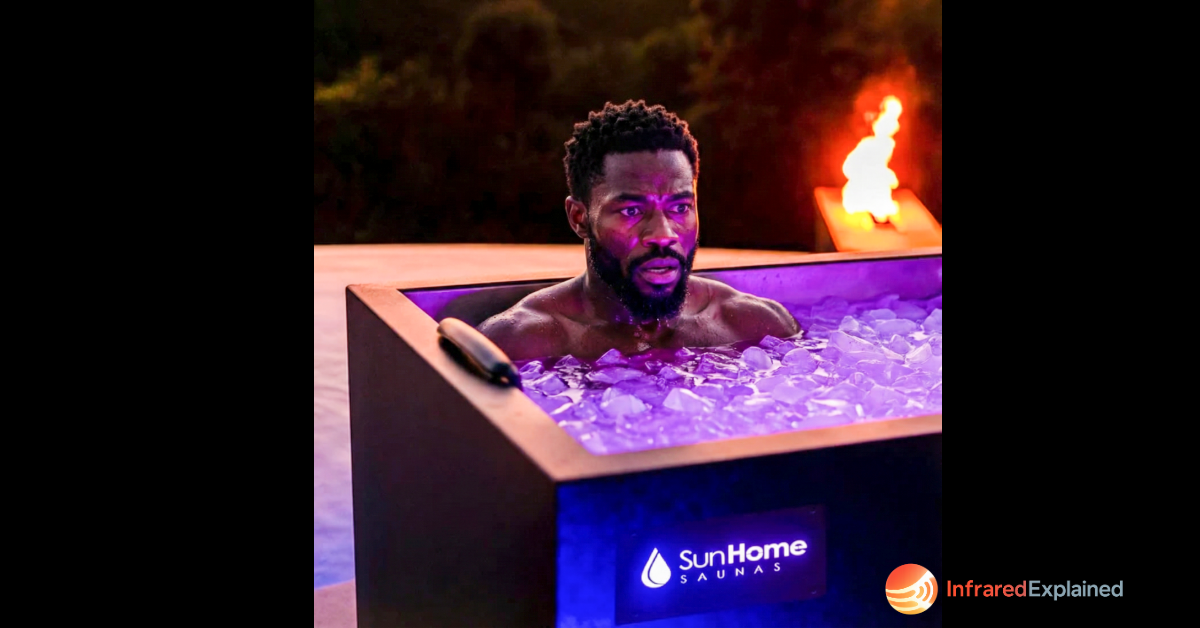
BLUF (Bottom Line Up Front)
Contrast therapy isn’t about chasing extremes or proving toughness. When done correctly at home with an infrared sauna and a cold plunge, it becomes a precision recovery tool that works with your physiology instead of against it.
By intentionally alternating heat and cold, you train your blood vessels to expand and contract efficiently, guide inflammation rather than suppress it, and teach your nervous system how to move from stress into recovery without getting stuck in either state. That transition is where real recovery happens. Not during the heat. Not during the cold. Between them.
Contrast therapy does not replace sleep, nutrition, or intelligent training. But when those foundations are in place, they act as a recovery multiplier. It helps athletes, biohackers, and high performers downshift faster after stress, recover more predictably, and show up again with clarity rather than lingering fatigue.
Used with intention, contrast therapy becomes less about sensation and more about adaptation.
-
What actually happens inside the body when heat and cold are alternated in the same recovery session?
-
Why do some athletes feel clearer and calmer after contrast therapy, while others feel drained?
-
How does contrast therapy train the nervous system rather than simply relaxing the muscles?
These are the questions that separate trend-following from understanding.
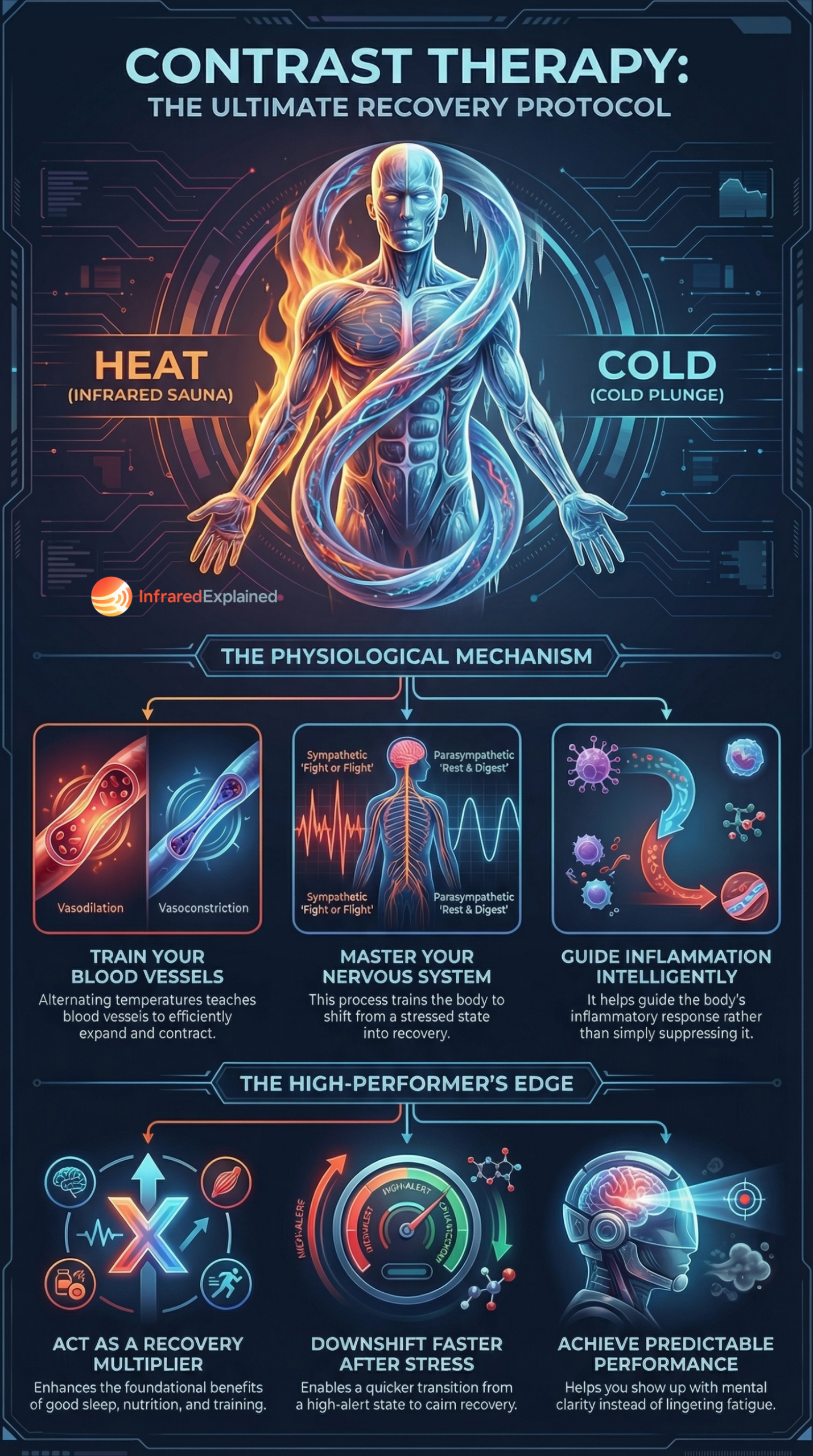
Table of Contents
- Introduction
- What Is Contrast Therapy and How Does It Work?
- What Does Alternating Heat and Cold Actually Do to the Body?
- How Is Traditional Sauna and Ice Bath Contrast Different From Infrared Sauna and Cold Plunge?
- Why Does Timing and Sequencing Matter in Contrast Therapy?
- How Does Contrast Therapy Influence Inflammation After Training?
- How Does Contrast Therapy Regulate the Nervous System?
- Why Infrared Sauna and Cold Plunge Work Well Together
- What Happens in the Body During a Contrast Therapy Session?
- Final Thoughts From a Lifetime BioHacker
- FAQs
Introduction
I’ve watched recovery trends come and go. Foam rolling became a ritual. Ice baths became a badge of toughness. Saunas turned into wellness status symbols. Most of these tools work to some degree, but only when they’re used with intention and understood at a physiological level.
Contrast therapy is different.
What used to live quietly in professional athletic training rooms is now showing up in garages, home gyms, and backyard wellness setups. The reason is simple. Contrast therapy works with the body’s natural stress and recovery systems instead of fighting them. By alternating heat and cold, you’re not just chasing temporary relief. You’re training your circulation, your inflammation response, and your nervous system to recover more efficiently.
At its core, contrast therapy is about controlled stress. Heat creates one signal. Cold creates another. The transition between the two forces the body to adapt. Blood vessels open and close. Inflammatory responses shift. The nervous system learns how to move from alert to calm without staying stuck in either extreme.
What makes today’s at-home contrast therapy different is the pairing of infrared saunas and cold plunges. Infrared saunas deliver deep tissue heat at lower air temperatures, making heat exposure more tolerable and repeatable. Cold plunges allow for precise cold exposure without the unpredictability of ice baths. Together, they create a system that’s not just effective, but sustainable.
This matters because recovery isn’t about how hard you can push your body once. It’s about how well you can show up again tomorrow.
Contrast therapy isn’t a shortcut. It doesn’t replace sleep, nutrition, or intelligent training. But when those foundations are in place, alternating infrared heat and cold immersion becomes a powerful multiplier. It helps the body switch gears faster, calm down sooner, and rebuild more efficiently after stress.
In this article, I’ll break down exactly how contrast therapy impacts circulation, inflammation, and nervous system regulation, what the research actually supports, and how to apply it safely at home without turning recovery into another form of punishment.
Because real recovery isn’t about enduring discomfort, it’s about teaching your body when to push and when to let go.
What Is Contrast Therapy and How Does It Work?
Contrast therapy is simple in concept, but powerful in effect.
At its most basic level, contrast therapy is the intentional alternation between heat and cold exposure to trigger a recovery response in the body. Heat and cold send opposing signals to your nervous system, blood vessels, and inflammatory pathways. When you alternate between them in a controlled way, you create a physiological training effect that helps your body recover more efficiently from stress.
This is not about toughness or shock value. It’s about controlled inputs that teach the body how to switch states.
What Does Alternating Heat and Cold Actually Do to the Body?
Heat and cold each have distinct effects.
When you expose your body to heat, especially through an infrared sauna, blood vessels dilate. Circulation increases. Muscles relax. The body moves toward a parasympathetic state, often described as “rest and digest.” Heat tells your system that it’s safe to downshift.
Cold exposure does the opposite. Blood vessels constrict. The nervous system becomes more alert. Cold activates the sympathetic response and sharpens awareness. It’s a short, controlled stress that forces the body to respond.
Contrast therapy works because the transition between these two states matters more than either one alone. Moving from heat to cold and back again creates a pumping action in the vascular system and trains the nervous system to shift smoothly between stress and recovery, rather than staying stuck in one mode.
That adaptability is where the recovery benefit lives.
How Is the Traditional Sauna and Ice Bath Contrast Different From the Infrared Sauna and Cold Plunge?
Traditional contrast therapy usually involves very hot, high-humidity or dry saunas followed by ice baths. It works, but it’s not always practical or sustainable for home use.
The infrared sauna and cold plunge contrast differs in a few crucial ways.
Infrared saunas heat the body directly rather than heating the air aggressively. This allows for deep tissue warming at lower ambient temperatures, which many people find more tolerable and more manageable to repeat consistently. You’re warming muscle and connective tissue without overwhelming your cardiovascular system.
Cold plunges, when properly set up, offer controlled cold exposure rather than the unpredictable shock of ice baths.
Try My Cold Plunge Decision Tool
Temperature can be dialed in. Exposure time can be measured. This makes the stress deliberate rather than chaotic.
Together, infrared sauna and cold plunge create a contrast experience that is precise, repeatable, and scalable, which is exactly what you want in a recovery practice.
Why Does Timing and Sequencing Matter in Contrast Therapy?
Contrast therapy is not just about exposing yourself to heat and cold. It’s about how and when you apply those signals. Order matters. Duration matters. Transitions matter. Get those wrong, and contrast therapy becomes stress for its own sake. Get them right, and it becomes recovery.
I’ve learned this the hard way.
Why Starting With Heat Matters
Most contrast protocols begin with heat, and that’s not tradition or comfort bias. It’s physiology.
Try My Infrared Sauna Decision Tool
Heat prepares the body for stress. Infrared sauna exposure increases circulation, relaxes tight tissue, and lowers baseline nervous system tension. Blood vessels open. Muscles soften. The body shifts toward a parasympathetic state, where it’s more receptive and less reactive.
When you enter cold after heat, the nervous system response is sharper but more controlled. You still get the alertness and vascular constriction that cold provides, but without overwhelming the system. The body experiences cold as a signal, not a threat.
This is especially important after training, when the nervous system is already activated, and tissues are inflamed. Heat first creates a buffer. It sets the stage for adaptation instead of shock.
Why Cold First Is Usually the Wrong Move After Training
Cold first has its place, but it’s a narrow one.
Starting with cold immediately spikes the sympathetic nervous system. Heart rate increases. Breathing shortens. Stress hormones rise. In some contexts, like mental alertness or resilience training, it can be useful.
After a hard workout, though, it’s often unnecessary and counterproductive. The body is already stressed. Throwing cold on top of that without preparation can push the system further into fight-or-flight instead of guiding it toward recovery.
For most people, especially those training consistently, cold first isn’t recovery. It’s another workout for the nervous system.
Why Duration Is More Important Than Intensity
More heat doesn’t equal more benefit. More cold definitely doesn’t.
Long heat exposure can lead to excessive dehydration and cardiovascular strain. Extended cold exposure can overshoot the intended stress response, leaving you feeling flat, fatigued, or irritable afterward.
The goal of contrast therapy is to create clear, intentional signals, not to see how much discomfort you can tolerate. Short, focused exposures tend to produce better outcomes than extreme ones.
When I finish a contrast session feeling wiped out, I know I’ve gone too far. Recovery should leave you restored, not depleted.
Why Transitions Are Where the Real Adaptation Happens
The real power of contrast therapy isn’t in the heat or the cold alone. It’s in the transition between them.
Moving from heat to cold trains the vascular system to open and close efficiently. Moving from stress to calm trains the nervous system to switch states without resistance. Over time, this improves resilience, not just recovery.
This is why rushing transitions matters. Jumping straight from extreme heat into extreme cold without awareness can overwhelm the system. Slowing the transition, even briefly, allows the body to process the signal instead of bracing against it.
What Well-Designed Contrast Therapy Should Feel Like
Good contrast therapy doesn’t leave you buzzing or drained. It leaves you grounded.
When timing and sequencing are right, you finish a session feeling clear, calm, and alert at the same time. Muscles feel loose. Breathing feels deeper. The nervous system feels settled, not sedated.
That’s the signal that your body didn’t just endure the session. It adapted to it.
And that’s the point.
How Does Contrast Therapy Influence Inflammation After Training?
Inflammation gets a bad reputation in fitness circles, but the truth is more nuanced. Not all inflammation is bad, and trying to eliminate it can actually slow progress. Contrast therapy works not by shutting inflammation down, but by helping the body manage it more intelligently.
That distinction matters.
What Is Exercise-Induced Inflammation and Why Do We Need It?
When you train hard, you create microdamage in muscle tissue. This triggers an inflammatory response that signals repair, adaptation, and growth. It’s how muscles get stronger and how endurance improves. Without inflammation, there is no adaptation.
This short-term, localized inflammation is exercise-induced, and it’s both normal and necessary. The problem arises when inflammation becomes excessive, prolonged, or systemic. That’s when soreness lingers, joints ache, sleep suffers, and recovery stalls.
Contrast therapy isn’t about eliminating the signal. It’s about preventing the signal from overstaying its welcome.
How Is Chronic Inflammation Different From Training Inflammation?
Chronic inflammation is a different animal altogether. It’s low-grade, persistent, and often disconnected from actual tissue repair. Poor sleep, constant stress, under-recovery, and overtraining all contribute to it.
When inflammation remains elevated beyond the window where adaptation occurs, it becomes noise rather than a signal. Recovery slows. Injury risk rises. Performance plateaus.
The goal of recovery tools like contrast therapy is to help the body resolve inflammation once it’s done its job, not block it from happening in the first place.
What Role Does Heat Play in Inflammatory Recovery?
Heat, especially infrared heat, increases blood flow and relaxes tissue. This matters because circulation is how the body moves inflammatory byproducts away from stressed areas and delivers nutrients needed for repair.
Heat also reduces muscular guarding. When muscles stay tense after training, inflammation tends to linger. Infrared heat helps muscles relax, creating a more favorable environment for recovery.
In practical terms, heat helps the body process inflammation rather than trap it.
What Role Does Cold Play in Inflammatory Control?
Cold exposure temporarily reduces inflammatory signaling and limits excessive swelling. Blood vessels constrict. Nerve conduction slows. The immediate sensation is one of numbing and calm.
This is useful in short, controlled doses. Cold doesn’t erase inflammation, but it can dampen runaway inflammatory responses that contribute to excessive soreness or joint irritation.
The key is restraint. Prolonged or overly aggressive cold exposure can suppress the very signals responsible for adaptation, mainly when used immediately after strength training.
Why Contrast Therapy Modulates Inflammation Instead of Blunting Adaptation
This is where contrast therapy shines.
By alternating heat and cold, you avoid the extremes. Heat supports circulation and tissue relaxation. Cold provides a temporary check on excessive inflammation. The transition between them encourages balance rather than shutdown.
Instead of telling the body “stop responding,” contrast therapy says, “respond, then resolve.” That’s a critical difference.
This modulation allows inflammatory signaling to do its job early, then taper appropriately. It’s why many athletes report reduced soreness without feeling flat or under-recovered the next day.
Why Recovery Support Is Not the Same as Adaptation Suppression
This is one of the most misunderstood areas of recovery science.
Some modalities, like prolonged cold immersion immediately after resistance training, have been shown to blunt muscle hypertrophy by suppressing anabolic signaling. That doesn’t mean all cold exposure is harmful. It means timing and dosage matter.
Contrast therapy, when applied thoughtfully, supports recovery without entirely suppressing the adaptive process. Short cold exposures following heat are less likely to interfere with growth signals than long, standalone ice baths.
Recovery support helps you train again. Adaptation suppression slows progress. The goal is to stay on the right side of that line.
What Contrast Therapy Should Feel Like After Training
Well-designed contrast therapy doesn’t leave you numb or drained. It leaves you settled.
Muscles feel looser. Joints feel calmer. The nervous system feels balanced instead of sedated. Soreness may still be present, but it feels manageable, not overwhelming.
That’s when you know inflammation has been guided, not silenced.
How Does Contrast Therapy Regulate the Nervous System?
If recovery tools worked only on muscles, most athletes would already be overtrained. The nervous system is the real bottleneck, and contrast therapy works because it trains that system directly.
When I started paying attention to how my nervous system felt after training, not just how my muscles felt, contrast therapy began to make sense differently. Heat and cold don’t just affect tissue. They send instructions to the brain.
How Cold Exposure Activates the Sympathetic Nervous System
Cold exposure is a controlled stressor. The moment cold hits the skin, the sympathetic nervous system switches on. Heart rate increases. Breathing becomes shallow and fast. Alertness spikes. This is the fight-or-flight response doing precisely what it evolved to do.
In short bursts, this is not harmful. It’s useful.
Cold exposure trains the nervous system to respond to stress quickly and decisively. It sharpens focus and increases mental clarity. That’s why many people feel awake and energized immediately after a cold plunge.
The key is dosage. Short, intentional cold exposure activates the system without overwhelming it. Long or uncontrolled cold exposure keeps the body stuck in a stress state, which is counterproductive for recovery.
How Heat Exposure Activates the Parasympathetic Nervous System
Heat does the opposite.
Infrared sauna exposure encourages parasympathetic activation, often referred to as rest and digest. Breathing slows. Muscles relax. Heart rate gradually decreases. The body shifts into a state where repair becomes possible.
Heat tells the nervous system that the threat has passed. It’s safe to let go.
This is especially important after training, when sympathetic drive is already elevated. Heat helps downshift the system, making recovery more efficient and sleep more accessible later in the day.
Why Contrast Therapy Trains Nervous System Flexibility
The real benefit of contrast therapy isn’t the cold or the heat alone. It’s the ability to move between them smoothly.
Life and training both demand nervous system flexibility. You need to turn stress on when required and turn it off when it’s no longer helpful. Many people lose this ability. They live stuck in a state of high alert or in chronic fatigue.
Contrast therapy trains transitions. Moving from heat to cold and back again teaches the nervous system that stress is temporary and controllable. Over time, this improves resilience, not just tolerance.
Resilience means you recover faster, sleep better, and respond to stress without spiraling.
Why Nervous System Balance Matters for Sleep, Stress, and Recovery
When the nervous system stays in a sympathetic state too long, sleep suffers. Recovery stalls. Stress becomes cumulative.
Balanced nervous system regulation allows you to fall asleep more easily, reach deeper sleep stages, and wake up feeling restored. It also reduces baseline stress levels, making training feel productive instead of draining.
This is why recovery strategies that ignore nervous system regulation eventually fail. Muscles recover. The nervous system does not.
Why Athletes Often Feel Energized Yet Calm After Contrast Therapy
This is the hallmark of effective contrast therapy.
After a well-designed session, many athletes report feeling alert but relaxed, focused but grounded. That combination is not accidental. It’s the nervous system operating in balance.
Cold provides the spark. Heat provides the landing. The alternation teaches the body how to experience stress without holding onto it.
When I finish a contrast session feeling energized yet calm, I know the system has adapted, not just endured.
That’s when contrast therapy stops being a recovery tool and becomes nervous system training.
Why Infrared Sauna and Cold Plunge Work Well Together
Not all contrast therapy setups are created equal. I’ve experimented with traditional saunas, steam rooms, ice baths, cold showers, and makeshift versions that looked good on social media but felt terrible in practice. What I’ve learned is this: infrared sauna and cold plunge work well together because they create precision instead of chaos.
Recovery thrives on signals the body can understand and repeat. This pairing delivers precisely that.
Why Infrared Sauna Works Better Than Traditional Sauna for Contrast Therapy
Traditional saunas rely on extremely hot air. That heat can be adequate, but it’s also blunt. High ambient temperatures place a heavier load on the cardiovascular system and often limit how long or how frequently sessions can be repeated.
Infrared saunas work differently. Instead of heating the air aggressively, they warm the body directly. This allows for deep tissue heating at lower air temperatures. Muscles, connective tissue, and joints warm without the same level of respiratory or cardiovascular strain.
For contrast therapy, this matters. You want heat that prepares the body, not heat that exhausts it before you ever reach the cold phase.
Why Lower Air Temperature With Deeper Tissue Warming Matters
Lower air temperatures mean the nervous system stays more regulated during the heat phase. Breathing remains steady. Heart rate rises gradually instead of spiking. Muscles relax without the body feeling overwhelmed.
At the same time, infrared wavelengths penetrate deeper into tissue, warming muscles where recovery actually happens. This combination makes infrared heat both effective and sustainable.
If you want to do contrast therapy once a month, extreme heat might be fine. If it’s something you want to do multiple times a week, infrared becomes the smarter tool.
Why Controlled Cold Exposure Beats Uncontrolled Cold Stress
Cold exposure is powerful, but it’s easy to misuse.
Uncontrolled ice baths introduce variability. Water temperature changes. Ice melts unevenly. Exposure often becomes a test of willpower rather than a signal of recovery. That unpredictability turns a tool from cold into a stress event.
A cold plunge allows for controlled, repeatable exposure. Temperature stays consistent. Duration can be measured. The nervous system receives a clear signal instead of a shock.
This matters because recovery depends on dosage. Cold works best when it’s deliberate, brief, and followed by resolution, not when it pushes the body into a prolonged fight-or-flight response.
Why This Pairing Is More Tolerable and Repeatable at Home
Recovery tools only work if you actually use them.
Infrared sauna and cold plunge contrast is more tolerable because neither extreme overwhelms the system. Heat feels supportive rather than punishing. Cold feels sharp but manageable. The experience encourages consistency instead of avoidance.
At home, repeatability matters more than intensity. A pairing you can use three to four times per week will outperform an extreme setup you avoid or recover from.
That’s why this combination works so well in real life, not just in theory.
What Happens in the Body During a Contrast Therapy Session?
Understanding contrast therapy becomes much easier when you look at it as a sequence, not a single event.
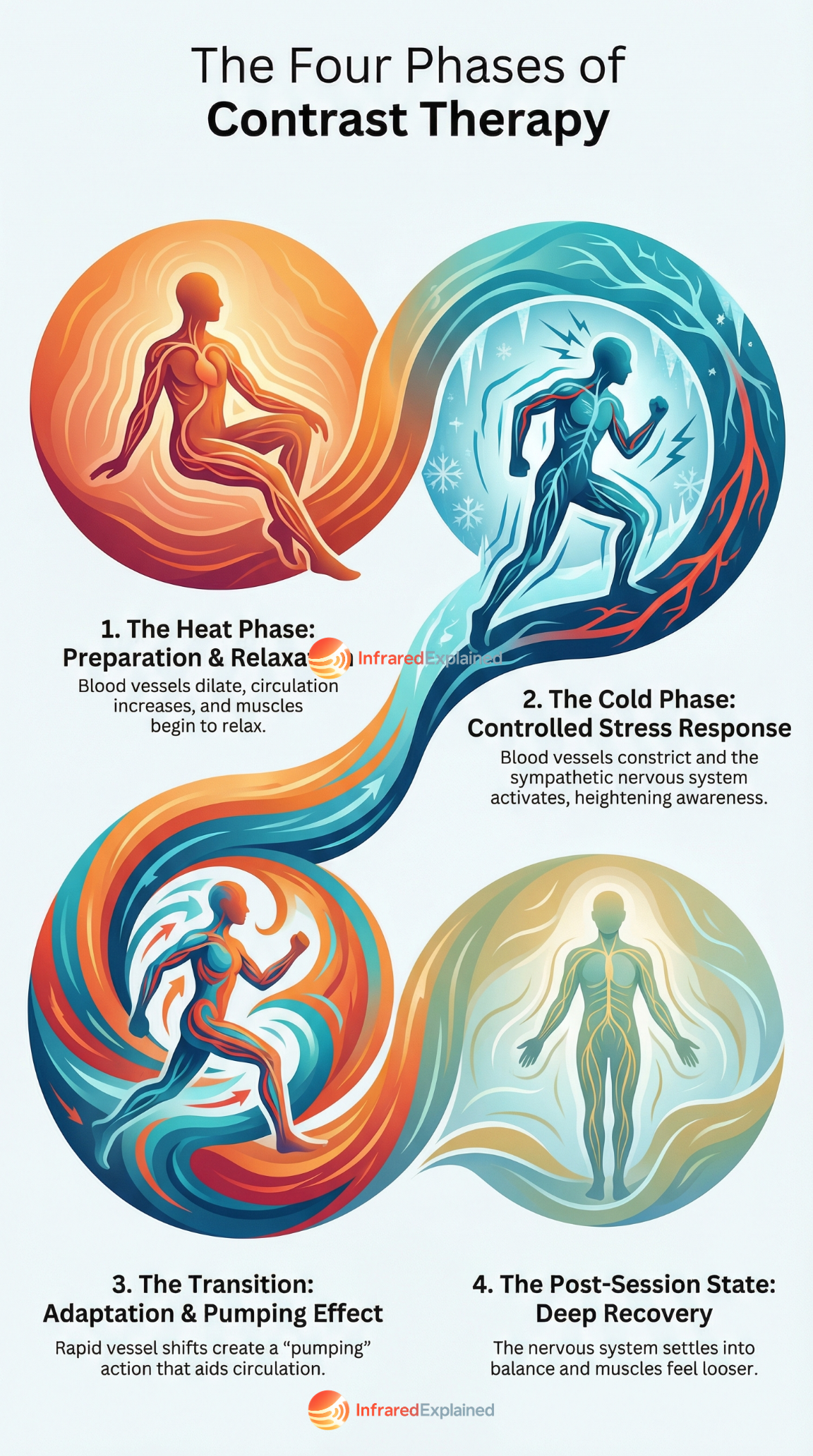
Each phase builds on the one before it.
Step One: The Heat Phase
The session usually begins with heat.
As you enter the infrared sauna, blood vessels dilate and circulation increases. Muscles begin to relax. Tissue temperature rises. The nervous system begins to shift away from high alert and toward recovery.
Breathing deepens. Tension decreases. The body becomes more receptive instead of defensive.
This phase prepares the system. It’s not about sweating as much as possible. It’s about creating openness, both physically and neurologically.
Step Two: The Cold Phase
After heat, the cold plunge introduces a sharp but controlled stress.
Blood vessels constrict. The sympathetic nervous system activates. Breathing may initially shorten, then stabilize as you adapt. Awareness heightens.
Because the body was prepared by heat, this cold exposure feels intense but not chaotic. The nervous system responds quickly, then settles instead of spiraling.
This phase provides contrast. It wakes the system up without leaving it stuck there.
Step Three: The Transition Effects
The transition between heat and cold is where much of the adaptation happens.
Blood vessels rapidly shift from dilation to constriction. This creates a pumping effect that supports circulation and waste removal. The nervous system practices switching states instead of lingering in stress or relaxation.
These transitions teach the body that stress has an endpoint. That lesson carries over into training, sleep, and daily life.
Step Four: The Post-Session Recovery State
After the final round, the body enters a recovery-dominant state.
Circulation normalizes. The nervous system settles into balance. Muscles often feel looser. Joints feel calmer. Breathing feels deeper and slower.
This is when many people notice the real benefits. Not during the cold. Not during the heat. After.
Why People Often Report Mental Clarity and Reduced Soreness
Mental clarity comes from nervous system balance. Contrast therapy sharpens alertness without leaving residual stress. That’s why people often feel focused but calm afterward.
Reduced soreness results from improved circulation, tissue relaxation, and modulation of inflammation. The body has been guided through stress and resolution instead of left stuck in either.
When people say that contrast therapy “resets” them, this is what they mean.
What a Good Contrast Session Should Leave You With
You shouldn’t finish exhausted. You shouldn’t feel numb. You shouldn’t feel wired.
You should feel clear, steady, and restored.
That’s how you know the pairing worked.
Final Thoughts From a Lifetime BioHacker
I’ve learned over the years that the most effective recovery tools aren’t the ones that feel extreme. They’re the ones that work quietly, consistently, and predictably in the background of your training life. Contrast therapy earns its place in a recovery routine not because it’s trendy, but because it respects how the body actually adapts to stress.
When infrared sauna and cold plunge are combined thoughtfully, contrast therapy becomes more than a sensation. It becomes a training signal for circulation, inflammation management, and nervous system regulation. It helps the body practice transitioning from effort to recovery instead of staying stuck in one mode. That’s something few recovery tools address directly.
That said, contrast therapy isn’t for everyone at all times.
Athletes training hard, fitness-focused individuals, and people who respond well to heat and cold tend to benefit the most. Those dealing with cardiovascular conditions, unmanaged blood pressure issues, or chronic fatigue should proceed cautiously and consult a medical professional before making contrast therapy a regular practice. Recovery should always move you forward, not test your limits.
One of the biggest mistakes I see is treating contrast therapy like a challenge instead of a habit. Consistency beats intensity every time. Short, repeatable sessions, done two or three times a week, will outperform extreme exposures that leave you drained or hesitant to repeat. If recovery feels like punishment, something is off.
Contrast therapy also works best when it’s part of a system. No sauna or cold plunge can compensate for poor sleep, inadequate nutrition, or constant overtraining. When recovery is treated as a whole, contrast therapy becomes a multiplier rather than a crutch. It amplifies the benefits of good habits instead of trying to replace them.
For me, that’s the real value.
Contrast therapy doesn’t promise shortcuts. It supports the long game. When used with intention, it helps you show up again tomorrow with clarity, steadiness, and resilience. And in the end, that’s what sustainable performance is built on.

Gabriel H.
Author & Founder of InfraredExplained
Lifetime BioHacker
FAQs
1. What is contrast therapy, and why do people use it for recovery?
Contrast therapy is a recovery method that alternates heat and cold exposure to help regulate circulation, inflammation, and the nervous system. People use it to recover more efficiently after training and reduce lingering soreness without suppressing adaptation.
2. Is infrared sauna and cold plunge contrast therapy safe to do at home?
For healthy individuals, infrared sauna and cold-plunge contrast therapy can be performed safely at home when exposures are controlled and gradual. Anyone with cardiovascular conditions or blood pressure concerns should consult a medical professional first.
3. Should contrast therapy start with heat or cold?
Most contrast therapy protocols start with heat because it prepares the body by increasing circulation and relaxing tissue before introducing cold. Starting with heat generally leads to a more controlled nervous system response.
4. How often should contrast therapy be used for recovery?
Contrast therapy is commonly used two to three times per week, depending on training load and recovery needs. Consistency with moderate exposure is more effective than frequent or extreme sessions.
5. Does contrast therapy reduce inflammation or just numb soreness?
Contrast therapy helps modulate inflammation rather than eliminate it. Heat supports circulation and tissue relaxation, while cold temporarily reduces excessive inflammatory signaling, allowing recovery without blocking adaptation.